All Media is Constructed
Content doesn't just "happen." It is designed by someone with a specific goal. Every choice — from the camera angle to the background music — is meant to make you feel something.
Free and open educational curriculum
A free, open curriculum for navigating the information landscape and filtering the signal from the noise.
18 weeks of guided lessons that teach young learners to see media not as a window into reality, but as a series of designed artifacts — built by people, delivered by algorithms, and amplified by sharing.
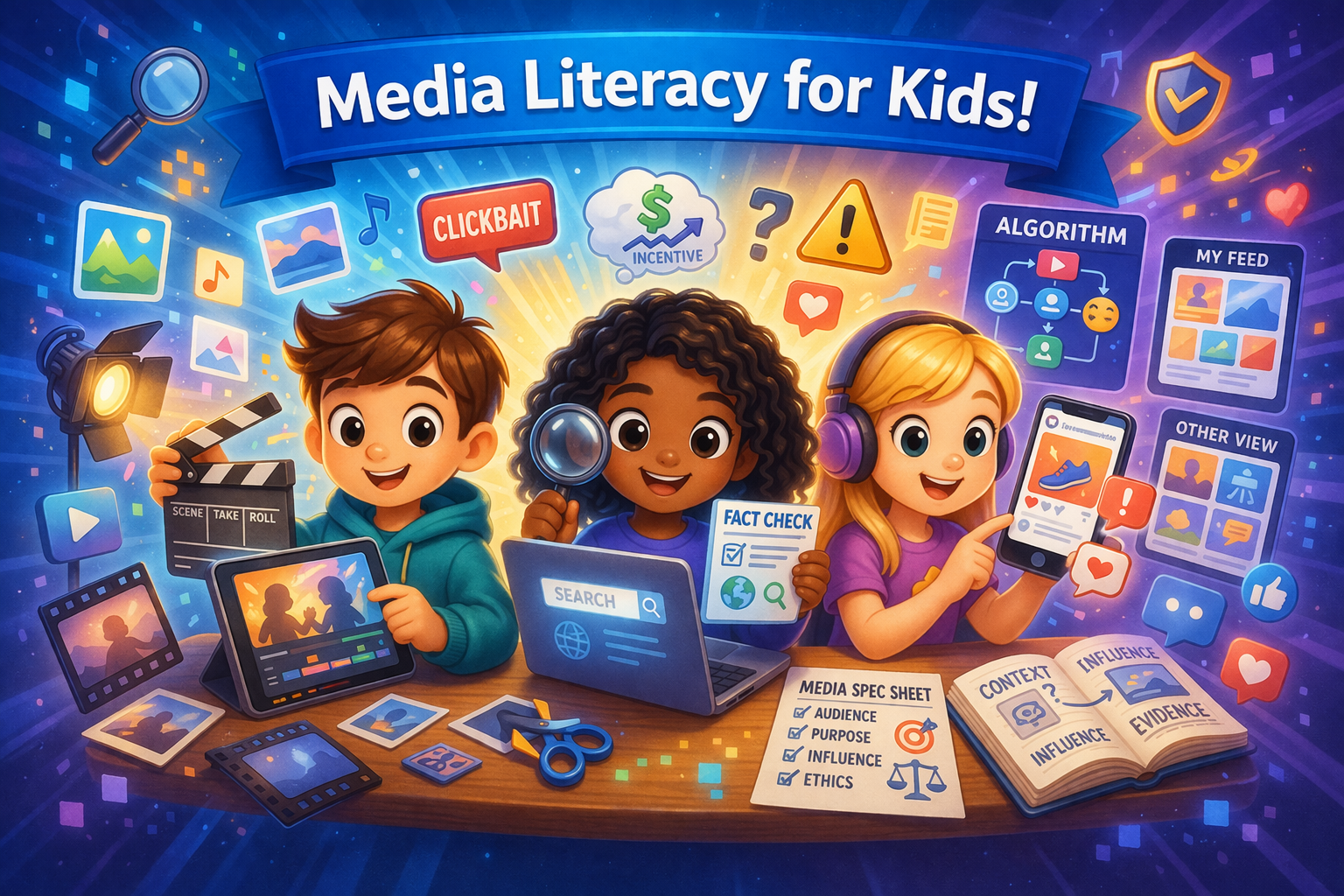
Most kids (and adults) take in media without thinking about where it came from, why it was made, or how it was designed to make them feel. This curriculum helps young learners become thoughtful, active readers of the media around them. They learn to notice the choices behind every message — who made it, why, and what techniques were used — and to check information carefully before trusting or sharing it.
This curriculum is part of Literacy for Kids, a collection of open-source curricula designed to help children ages 8–12 understand the systems that shape the modern world.
Each curriculum explores a foundational literacy:
Open-source curricula for children ages 8–12, designed to help kids understand the systems that shape modern life.
Five ideas that thread through every lesson, helping students move from passive media consumers to thoughtful, curious questioners.
Content doesn't just "happen." It is designed by someone with a specific goal. Every choice — from the camera angle to the background music — is meant to make you feel something.
To understand a message, follow the money. If the content is free, ask what's paying for it — often, your attention is the product being sold. Students learn to ask: is the creator trying to inform, to sell, or to provoke?
Digital platforms tend to prioritize content that keeps users engaged. This can mean high-emotion content gets promoted over more accurate or balanced material — not through malice, but through the mechanics of engagement-based ranking.
A video clip or a quote without its original context can mean anything. You can't judge information fairly if you don't know where it came from and what surrounds it.
When you like, share, or comment, you aren't just watching — you are amplifying a message, much like writing changes a document. Every share sends information further into the network, and students learn the responsibility that comes with it.
Designed for ages 8–12 and usable by any caring adult — no media expertise required.
Work through lessons at home with one child or siblings. Sessions are designed for the kitchen table.
Supplement ELA, social studies, or digital citizenship instruction with a structured weekly program.
A ready-to-use unit with flexible pacing, built-in assessments, and standards-aligned outcomes.
Run a weekly after-school or summer program with hands-on activities that work in groups.
An 18-week progression that moves from the mechanics of how messages are built to the dynamics of the digital network that delivers them.
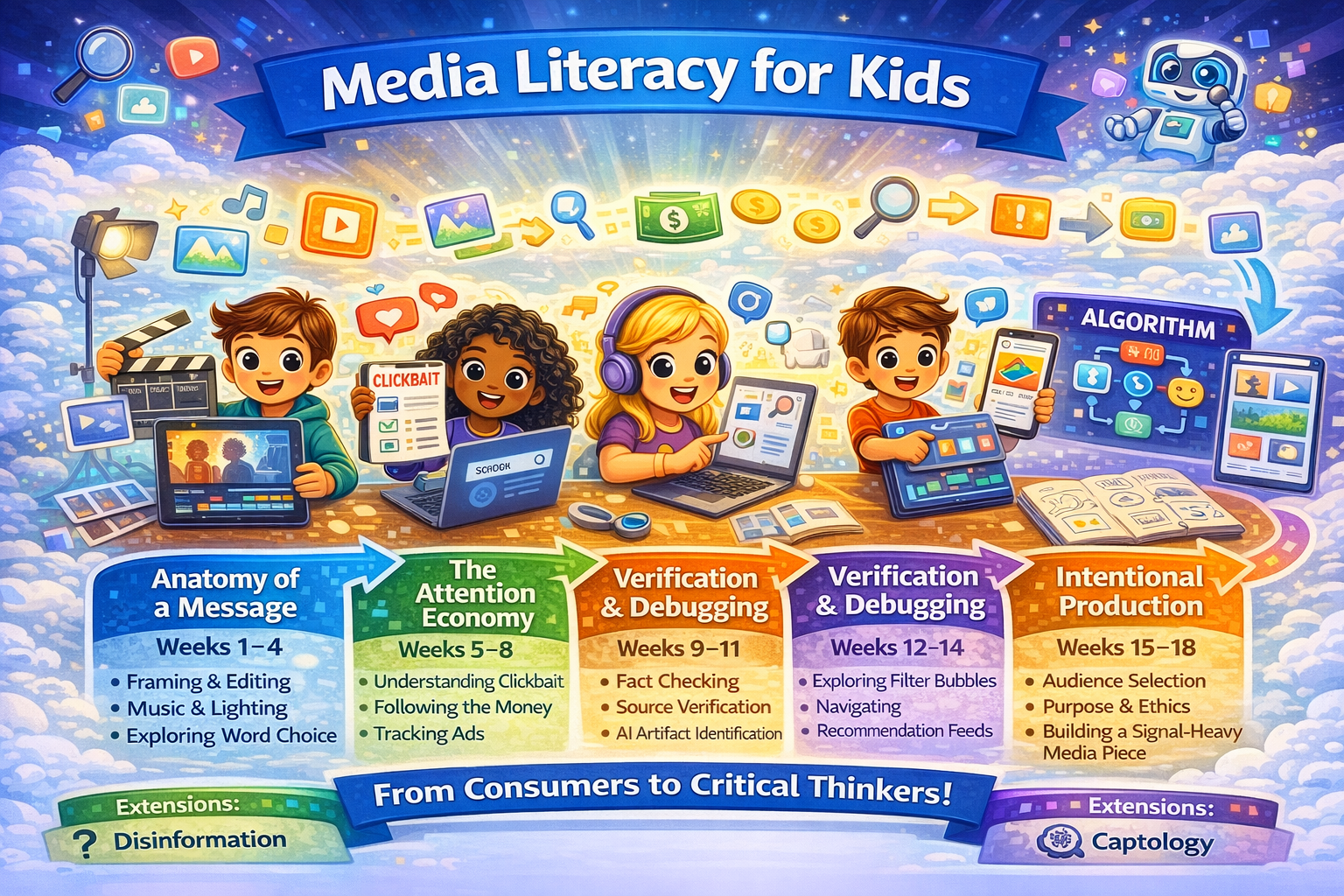
Weeks 1–4
Deconstructing Construction — Students look at the "engineering" of media. We analyze how lighting, editing, and word choice change how a story feels.
Weeks 5–8
The Monetization Protocol — How do YouTube, TikTok, and news sites stay in business? We explore clickbait, ads, and the business model behind "free" content.
Weeks 9–11
Signal-to-Noise Filtering — Students learn the tools of the trade: reverse image searches, lateral reading, and checking for manipulated or out-of-context media.
Weeks 12–14
Network Feedback Loops — We explore filter bubbles, confirmation bias, and how the "software" of a feed learns what you like and stops showing you anything else.
Weeks 15–18
Responsible Output — Students create their own media with a clear plan: Who is the audience? What is the goal? How do we build something honest and valuable?
Each week includes two guided sessions and one independent session — about 80–90 minutes total. No expertise required, minimal prep needed, and every lesson works with everyday media you already have at home or in the classroom.
Found a mistake or have a suggestion? Open an issue on GitHub.
Version 1.0
This curriculum is an open project and will continue to improve as teachers and families use it.