Probabilistic Outcomes
The world runs on likelihoods, not certainties. Kids learn to think in probabilities instead of "yes or no," building comfort with uncertainty.
Free and open educational curriculum
A free, open curriculum that teaches kids to debug the human brain.
18 weeks of hands-on activities covering probability, cognitive biases, game theory, and real-world problem solving — built for ages 8–12 with caregiver guidance.
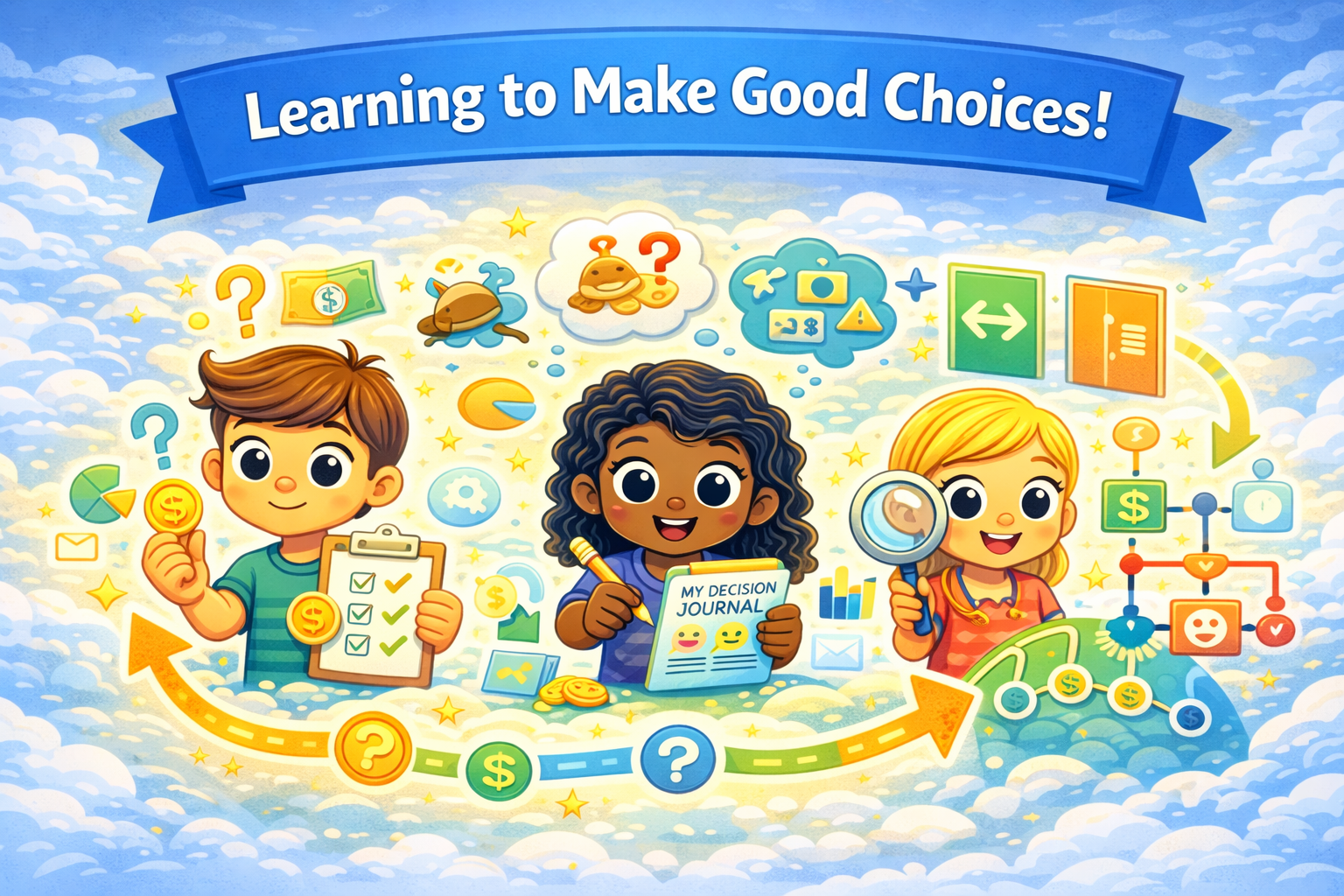
Decision Literacy for Kids is designed to help educators and families teach young learners how to think through choices, evaluate options, and reflect on outcomes. The lessons push students to analyze, evaluate, and create as they move through the course.
Open-source curricula for children ages 8–12, designed to help kids understand the systems that shape modern life.
The curriculum is organized around a set of mental models that help students understand decision-making in practical, durable ways.
The world runs on likelihoods, not certainties. Kids learn to think in probabilities instead of "yes or no," building comfort with uncertainty.
Our brains take mental shortcuts that usually help but sometimes mislead. Knowing your defaults is the first step to overriding them.
Every choice carries a hidden price tag — the next-best option you didn't pick. Seeing these invisible trade-offs transforms decision-making.
More isn't always better. The 10th hour of practice helps less than the 1st. Knowing when to stop optimizing is itself an optimization.
Few choices are permanent. Most can be tested, measured, and improved. Design → Test → Measure → Patch → Repeat.
The learning progression moves from foundational decision-making concepts into increasingly complex and creative applications.
Weeks 1–4
Randomness, probability, process vs. outcome thinking, and the Decision Journal — building the foundation for everything that follows.
Weeks 5–8
Heuristics, loss aversion, sunk costs, and the framing effect — turning the lens inward to study the brain's default settings.
Weeks 9–11
Expected value, signal vs. noise, and the reversible/irreversible framework — quantitative tools for cutting through uncertainty.
Weeks 12–14
Ripple effects, the Prisoner's Dilemma, and the Tragedy of the Commons — expanding from "me" decisions to "us" decisions.
Weeks 15–18
Identify a real friction point, design a protocol, test it with data, and iterate — applying every tool to a genuine personal challenge.
Begin with Week 1 and give students a clearer understanding of how to think through decisions thoughtfully.
Found a mistake or have a suggestion? Open an issue on GitHub.
Version 1.0
This curriculum is an open project and will continue to improve as teachers and families use it.